Choosing a Gait Analysis Pressure Mat is not simply a matter of selecting the largest sensor area or the highest sampling rate. The right system should answer a practical clinical or research question clearly. Will it assess walking symmetry, pressure distribution, balance, or footwear performance? Each purpose requires different measurement priorities. A rehabilitation clinic may value quick setup and repeatable reports. A biomechanics laboratory may need higher spatial resolution, synchronized video, and exportable raw data. These differences matter.
Real-world experience also exposes details that product brochures often overlook. A mat should remain stable on the floor, even during rapid turns. Its surface should feel natural under different shoes and walking speeds. Software must produce readable results without hiding important assumptions. Check calibration procedures, sensor durability, technical support, warranty terms, and independent validation. Ask how the manufacturer handles overloaded sensors and repeated daily use. Small practical weaknesses can distort otherwise impressive measurements.
There is no perfect choice.
Reliable selection requires comparing evidence, not impressive specifications alone. Published validation studies, transparent accuracy data, and demonstrations with representative users can strengthen confidence. Still, testing a system with your own participants is wiser than trusting a single sales claim. Children, older adults, athletes, and patients with uneven gait may interact with the mat differently. That difference should be documented. A careful buyer may discover that an initially preferred model is inconvenient, expensive to maintain, or poorly matched to the intended workflow. That is not failure. It is useful evidence for making a more defensible decision.
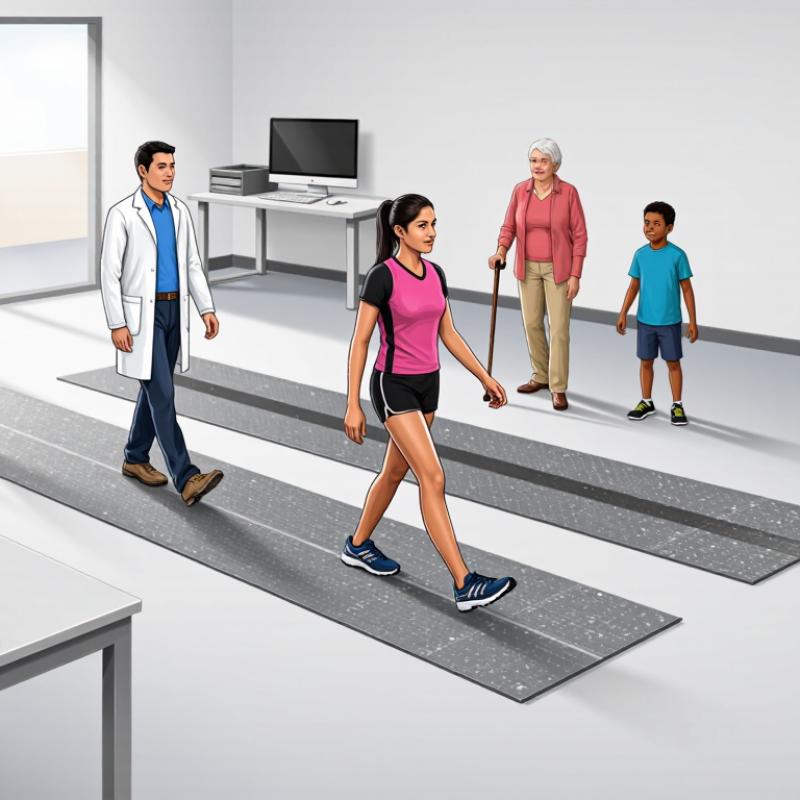
A gait analysis pressure mat measures how the feet interact with the ground during walking or running. Its sensors record plantar pressure across the heel, arch, forefoot, and toes. This creates a pressure map that shows where force is concentrated and how it shifts over time. High-pressure areas may appear beneath the heel or the ball of the foot. The pattern can change with speed, footwear, fatigue, or surface conditions.
The system can also measure contact time, step length, cadence, stance duration, and pressure differences between the left and right feet. Some analyses track the center of pressure, which represents the moving balance point under each foot. A smooth path may suggest controlled weight transfer, while an irregular path deserves closer observation. In practice, I would compare several walking trials instead of trusting one step. One step can mislead.
A pressure mat does not directly measure pain, muscle strength, joint motion, or injury. It records loading behavior, not the complete reason behind that behavior. Calibration, sensor resolution, walking speed, and foot placement affect the results. Barefoot testing and shod testing may also produce different pressure patterns. Clinicians should interpret these measurements alongside physical examination, medical history, and video analysis. Numbers are useful, but they are not self-explanatory.
This representative walking-trial chart shows peak plantar pressure across five foot regions. A pressure mat can also measure contact time, stance time, pressure distribution, center-of-pressure movement, and pressure-time loading.
When choosing a mat, compare pressure range, sensor density, sampling frequency, calibration stability, usable measurement area, and software analysis features. Peak-pressure values vary with walking speed, footwear, body mass, and measurement protocol.
Choosing a gait analysis pressure mat starts with the intended assessment. A clinic studying balance needs different details from a sports laboratory measuring running loads. Define the walking area, subject range, and movement speed before comparing specifications. Check active sensing length, sensor density, sampling rate, and pressure range. Higher resolution can reveal short contact changes, but it may also increase cost and data complexity. A wider mat helps capture natural steps, especially for users with longer strides.
Reliability depends on more than sensor numbers. Ask how calibration is performed, how often it should be repeated, and whether results remain stable after frequent use. The surface should resist slipping, cleaning fluids, and repeated foot traffic. Software also matters. Clear force maps, exportable files, and consistent reports support clinical decisions and peer review. In practice, confusing software can weaken an otherwise capable measurement system. I would test a sample session before purchasing. That small trial may expose awkward setup, delayed recording, or missing data fields.
Tips: Place the mat on a firm, level floor. Test barefoot and shod conditions when relevant. Compare repeated walks from the same person. Watch for edge effects, because partial steps can distort interpretation. Keep a simple maintenance log. Do not assume the most expensive option is the most suitable. I would also leave room for doubt: normal gait varies with fatigue, footwear, and attention, so one short trial should never carry the entire decision.
Choosing a gait analysis pressure mat requires more than reading “high accuracy” on a specification sheet. Accuracy depends on calibration, walking speed, footwear, and the reference system used. A 2022 review in Gait & Posture found that temporal measures, such as step time and walking speed, often showed intraclass correlation coefficients above 0.90. Pressure measurements varied more widely. I would not treat one excellent ICC as universal proof.
Size changes the test itself. A short mat may capture only one or two steps, increasing variability during acceleration and deceleration. A longer surface records more consistent strides, but it needs extra laboratory space. Compare the active length, usable width, sampling frequency, and maximum walking speed. A 2021 review in Sensors reported that validated systems commonly measured temporal parameters within roughly 2–5% of reference methods, yet spatial accuracy weakened when subjects changed speed.
Sensor layout deserves close attention. Dense sensors improve pressure mapping, especially near the heel, metatarsals, and toes. However, a narrow grid can miss lateral loading and uneven contact. Check sensor spacing, active coverage, calibration frequency, and whether adjacent sensors merge one contact region. The ISO 20685-1:2018 framework also reminds users to evaluate measurement uncertainty, not only repeatability. That distinction is easy to overlook. Personally, I would repeat trials across several speeds and include real clinical footwear. A clean laboratory result can still mislead.
A pressure mat is only as useful as the software supporting it. During clinical testing, I check whether the interface displays stance time, step length, cadence, peak pressure, and center-of-pressure paths clearly. These values help interpret balance and walking symmetry. The World Health Organization estimates that 1.71 billion people live with musculoskeletal conditions worldwide, increasing the need for dependable movement assessment tools (WHO, 2022). Clear software can reduce reading errors, but confusing menus still create avoidable mistakes.
Look closely at the exported data. A suitable system should provide raw pressure readings, calibrated values, timestamps, foot maps, and trial summaries. CSV export supports basic analysis, while C3D or API access helps connect motion laboratories and clinical databases. Sampling frequency also matters. A slow system may miss short loading events during rapid walking. Ask whether the software records calibration history, operator identity, and patient consent status. These details strengthen traceability and support quality procedures aligned with ISO 13485 principles.
COMPATIBILITY Compatibility needs practical testing. Confirm support for your operating system, local network rules, and existing electronic records. Check whether data can move without screenshots or manual retyping. I have seen technically impressive systems fail because their files could not open in common analysis software. No export is perfect. Request a sample dataset before purchase, then test it with your real workflow. Also examine update policies, user permissions, backup options, and training resources. A mat that produces attractive graphs may still be unsuitable if its data cannot be reviewed independently.
How to Choose a Gait Analysis Pressure Mat?
Start by defining the walking task. A clinic may need step timing, pressure distribution, and left-right comparisons. A sports laboratory may require faster sampling and repeated trials. Write these needs down before comparing specifications. Check the active sensing area, sensor spacing, sampling rate, and maximum load. A larger mat is not always better. It can make setup harder in a small testing room.
Test the mat with a consistent protocol. Mark the walking path and let each participant complete several passes at a comfortable speed. Record barefoot and footwear trials when both conditions matter. Use the same lighting, floor, and instructions. Compare repeated steps from the same person. Stable results matter more than attractive software screens. A useful system should show clear calibration records, exportable data, and readable reports. Ask how the supplier verifies accuracy and handles damaged sensors.
Small details can change results. A loose cable can disturb a trial. So can a participant looking down. Very short trials may hide natural variation. Do not trust one impressive recording. I would also place a known load on the mat during routine checks, although this does not replace formal calibration. Keep a test log with date, operator, footwear, walking speed, and environmental notes. Some decisions remain uncertain. A mat may perform well in demonstrations but behave differently after months of daily use. Trial access and technical support deserve the same attention as sensor specifications.
| Evaluation Dimension | What to Check | Practical Test or Question | Relevant Specification or Target | Why It Matters | Selection Guidance |
|---|---|---|---|---|---|
| Measurement Area | Usable sensing length and width, including the active measurement zone. | Confirm that the mat can capture several consecutive footfalls without forcing the subject to shorten or alter their stride. | Choose a sensing area appropriate to the subject’s walking speed, step length, and test protocol. | A measurement area that is too short may capture only part of a gait cycle and reduce the value of temporal and pressure comparisons. | Select the largest practical area that fits the available walkway and intended testing environment. |
| Sensor Resolution | Number of sensing elements per unit area and the detail of the pressure map. | Compare the visibility of the heel, midfoot, forefoot, and individual loading regions during slow-motion review. | Higher spatial resolution generally provides more detailed footprint and pressure-distribution information. | Fine structures such as localized forefoot loading or medial-lateral pressure shifts can be missed with coarse resolution. | Use higher resolution when the evaluation requires detailed foot-region analysis; moderate resolution may be sufficient for basic symmetry screening. |
| Sampling Rate | How frequently the system records pressure data during movement. | Ask whether the system can capture the fastest expected gait condition without visible gaps or distorted pressure transitions. | Walking analysis typically benefits from a sampling rate high enough to resolve heel strike, stance progression, and toe-off. | A low sampling rate can obscure short-duration events and make timing measurements less reliable. | Choose a higher sampling rate for running, rapid walking, athletic testing, or detailed event-timing analysis. |
| Pressure Range | The minimum and maximum pressure the mat can measure accurately. | Test unloaded areas, normal walking, and the highest expected loading condition while checking for saturation or clipped values. | The operating range should cover the full expected pressure distribution with sufficient headroom above peak values. | If the range is too low, high-load areas may saturate; if it is unnecessarily high, low-pressure changes may be harder to distinguish. | Match the range to the application, including clinical walking, balance work, rehabilitation, or sports movement. |
| Accuracy and Repeatability | Agreement with a known reference and consistency across repeated measurements. | Perform repeated trials with the same subject and compare peak pressure, contact area, stance time, and center-of-pressure paths. | Look for documented accuracy, repeatability, calibration procedures, and test conditions rather than relying only on nominal resolution. | Reliable trends require measurements that remain consistent when the same movement is repeated. | Prioritize independently verified performance data and a clear calibration protocol. |
| Calibration Stability | How long the mat maintains a stable baseline and measurement response. | Record several unloaded frames before and after testing, then check for baseline drift or changes in zero readings. | The system should provide a defined zeroing or calibration process and stable readings during the planned session. | Drift can create false pressure values and compromise comparisons between subjects or test sessions. | Avoid systems that require frequent unexplained recalibration or provide no way to verify baseline stability. |
| Dynamic Response | How quickly and consistently the sensors respond to changing loads. | Review pressure transitions during heel contact, foot loading, and toe-off at different walking speeds. | Response should be sufficiently fast to represent transient loading changes without excessive smoothing or delay. | Dynamic response affects the accuracy of pressure-time curves and center-of-pressure movement. | Test at more than one speed if the mat will be used for both rehabilitation and performance assessment. |
| Gait Variables | Whether the software calculates the variables required for the intended assessment. | Check for step count, step length, stride length, cadence, stance time, swing time, contact time, pressure zones, and symmetry measures. | The output should include raw or exportable data as well as summary metrics. | A technically capable mat may still be unsuitable if it cannot produce the variables needed for clinical or research workflows. | Create a checklist of required variables before comparing systems. |
| Center-of-Pressure Tracking | Ability to display and export the center-of-pressure path through stance. | Compare the path across repeated trials and inspect whether it follows expected heel-to-toe progression. | The system should show direction, timing, and left-right differences in the center-of-pressure trajectory. | Center-of-pressure data can help identify balance strategies, loading asymmetry, and altered foot progression. | Select a system that provides both visual paths and numerical coordinates or time-series export. |
| Walking Protocol | Compatibility with barefoot, socked, or shod testing and with the required walking distance. | Run the same subject under the real test conditions, including normal speed, self-selected speed, and any footwear used in practice. | The test setup should support the footwear, speed range, and number of passes required by the protocol. | Footwear, speed, and walking instructions can substantially influence pressure distribution and gait timing. | Choose a mat that can reproduce the intended protocol rather than selecting solely from laboratory specifications. |
| Data Synchronization | Timing alignment between pressure data and optional video, motion capture, force, or electromyography systems. | Check whether synchronization is hardware-based, software-based, manual, or unavailable. | Time stamps should remain consistent across devices during the complete recording. | Synchronization is important when pressure findings must be compared with joint motion, external forces, or visual events. | Require a documented synchronization method for multi-sensor studies. |
| Data Export | Availability and format of raw pressure frames, processed variables, and reports. | Export a sample session and verify that it opens correctly in commonly used analysis software. | Commonly useful formats include CSV or other structured formats that preserve time stamps and sensor data. | Exportable data supports independent analysis, auditability, research, and long-term record keeping. | Prefer systems that provide both raw data access and clearly documented processed outputs. |
| Surface and Construction | Mat thickness, flexibility, traction, edge transitions, and resistance to repeated loading. | Inspect the edges, place the mat on the intended floor, and check for movement, curling, or a noticeable step-up. | The walking surface should be stable, level, slip-resistant, and suitable for the expected test environment. | Surface irregularities can alter natural gait and increase trip risk or measurement variability. | Choose a low-profile, stable surface with clearly defined placement and cleaning requirements. |
| Portability and Setup | Weight, storage method, connection requirements, and time needed to begin a test. | Time the complete setup, including placement, connection, calibration, and removal. | The system should fit the available space and support the frequency of testing required by the workflow. | Complicated setup can reduce testing consistency and limit use outside a dedicated laboratory. | For shared rooms or field assessments, prioritize simple setup, secure connections, and easy transport. |
| Software Usability | Clarity of live displays, trial management, subject records, filtering, and report generation. | Ask a first-time operator to complete a test without assistance and note the number of steps and possible errors. | The interface should make calibration status, valid trials, rejected trials, and key metrics easy to identify. | Usable software improves operator consistency and reduces mistakes during repeated testing. | Choose software that matches the technical skill level of the staff who will operate it. |
| Quality Control | Procedures for checking sensor health, baseline values, missing data, and unusual readings. | Run a standardized quality-control routine before each session and document any failed checks. | The system should allow verification of zero readings, active channels, data completeness, and trial validity. | Quality-control records help distinguish genuine gait changes from equipment or setup errors. | Use a written pre-test and post-test checklist for every measurement session. |
| Maintenance and Service | Cleaning method, protective storage, sensor replacement, software updates, and technical support. | Review the maintenance schedule and confirm how faults, damaged surfaces, or abnormal sensor readings are handled. | Requirements should be practical for the expected test volume and operating environment. | Regular care helps preserve sensor response, hygiene, and measurement consistency. | Avoid selecting a system without clear maintenance instructions and a documented service process. |
| Pilot Comparison | Performance under the exact conditions in which the mat will be used. | Have the same subjects perform repeated trials on each candidate system using the same protocol. | Compare data completeness, repeatability, setup time, operator workload, and agreement with the required outcomes. | A short pilot often reveals practical limitations that are not visible in a specification sheet. | Make the final decision from measured workflow performance, data quality, and long-term usability. |
It records how each foot loads the ground while walking or running. Sensors map pressure under the heel, arch, forefoot, and toes. The system may also measure step length, cadence, contact time, and stance duration. It shows loading behavior, not the whole body.
It can show concentrated force beneath the heel or ball of the foot. It also tracks how pressure shifts during each step. The center-of-pressure path represents the moving balance point. An irregular path deserves closer observation.
One step can mislead. Repeat several walking passes at a comfortable speed. Compare steps from the same person under consistent conditions. Repeated patterns usually deserve more attention than one dramatic result.
No. It does not directly measure pain, muscle strength, joint motion, or injury. It records foot-loading behavior only. Physical examination, medical history, and video analysis remain important.
Walking speed, footwear, fatigue, and floor surfaces can alter pressure patterns. Barefoot and shod trials may look different. Foot placement also matters. Keep instructions, lighting, and walking paths consistent.
The interface should clearly display stance time, step length, cadence, peak pressure, and pressure paths. Exported files should include raw readings, calibrated values, timestamps, foot maps, and trial summaries. CSV files support basic analysis. More advanced connections may require C3D or API access.
Calibration history helps users understand whether measurements remain traceable. Record the date, operator, footwear, walking speed, and environmental notes. A known load can support routine checks. It does not replace formal calibration.
Mark a walking path and ask participants to complete several passes. Test barefoot and footwear conditions when relevant. Request a sample dataset before purchase. Check whether files open in existing analysis software without screenshots or manual retyping.
Not always. A larger sensing area may support longer steps, but it can complicate setup. Check room size, sensor spacing, maximum load, and sampling rate. The best size depends on the walking task.
Loose cables can disturb a trial. A participant looking down may change the movement pattern. Short trials can hide natural variation. Attractive graphs are not enough; independent data review still matters.
Choosing the right Gait Analysis Pressure Mat begins with understanding what it measures, including plantar pressure distribution, force patterns, timing, contact area, and changes in balance during standing or walking. These measurements can support clinical assessment, sports performance analysis, rehabilitation planning, and research. When comparing different systems, consider measurement accuracy, repeatability, active sensing area, mat size, sensor density, spatial resolution, sampling rate, and sensor layout. A mat should be large enough to capture natural steps while matching the testing environment and the movement patterns being studied.
Software and data output are equally important. Check whether the system provides clear visual reports, exportable data, useful analysis tools, and compatibility with existing computers or motion-analysis equipment. Before making a decision, define your testing goals, compare technical specifications, review setup and calibration requirements, and arrange practical trials when possible. Test the mat with different users, walking speeds, and footwear to evaluate consistency and ease of use. The best choice should balance performance, usability, durability, data quality, and long-term application needs.

MedTrack