Choosing a China-based Upper Limb Rehab Robot supplier requires more than comparing prices or polished demonstrations. Buyers should examine measurable clinical functions: shoulder and elbow assistance, wrist control, adjustable resistance, patient-specific calibration, and safe emergency stops. Ask for validation data, therapist training plans, maintenance response times, and evidence that the system supports real rehabilitation workflows. A smooth demo is not proof of clinical value.
The need is substantial. The World Stroke Organization’s 2022 Global Stroke Fact Sheet reports 12.2 million new strokes worldwide each year. Many survivors experience impaired arm and hand function, making accessible, repeatable practice important. MIT rehabilitation-robotics expert Hermano Igo Krebs’s published work highlights the value of intensive, task-specific practice enabled by robotic systems. This is a paraphrase, not a direct quotation. That distinction matters. Robotics should support therapists, not replace clinical judgment or individual assessment.
For buyers researching “China Best Upper Limb Rehab Robot Supplier?”, the practical question is which supplier can demonstrate dependable performance beyond the showroom. Compare published study methods, patient populations, and outcome measures; check whether claims match the evidence. Request a live trial with tasks such as reaching, grasping, or forearm rotation, and observe how staff adjust assistance. Fit matters. A device may look advanced yet prove difficult to calibrate, maintain, or integrate into daily care. The strongest supplier is not automatically the largest or least expensive; it is the one whose evidence, service, and training withstand careful review.
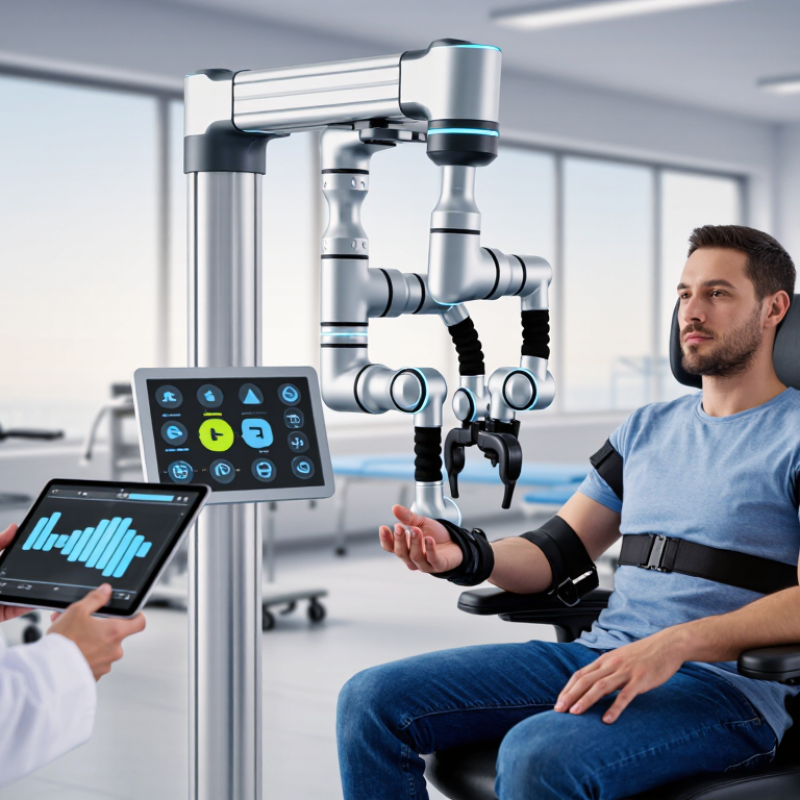
What Defines an Upper-Limb Rehabilitation Robot and Its Main Types?
An upper-limb rehabilitation robot is a device that supports or guides arm and hand movement during therapy. Sensors track motion, while motors or mechanical supports provide assistance or resistance. Clinicians can adjust the task and review measures such as range, speed, and repetition count. Fit matters. A system must match the user’s movement ability and treatment goals, not simply offer more repetitions.
Two common types are end-effector robots and wearable exoskeletons. End-effector devices guide the hand or forearm from a handle, often along a set path. Exoskeletons align mechanical joints with the user’s shoulder, elbow, or wrist, allowing more direct control of separate joints. Some systems train one arm; others coordinate both arms or use interactive screen tasks. The categories overlap, and a tidy label may hide important differences in comfort and setup. In a 2018 Cochrane review of 45 trials involving 1,619 people after stroke, robot-assisted arm training showed small average benefits in daily activities, arm function, and strength. Those findings support its use as a therapy tool, not a replacement for clinical assessment or hands-on practice.
Clinical Need: 12.2 Million New Strokes Worldwide in 2019 (GBD)
In 2019, an estimated 12.2 million people worldwide experienced a new stroke. The Global Burden of Disease Study 2019 also estimated 101 million people were living with stroke and 6.55 million died from it. These figures, published in The Lancet Neurology in 2021, show why recovery services need capacity, not just advanced equipment.
Many survivors have difficulty reaching a cup, opening the hand, or lifting an arm to dress. Small tasks can demand months of structured practice.
For hospitals evaluating an upper-limb rehabilitation robot supplier in China, the key question is how safely and consistently a device supports that practice. Look for adjustable assistance, clear movement records, and controls that therapists can use without disrupting sessions.
Measures such as the Fugl-Meyer Assessment for the Upper Extremity can help track motor changes; device activity alone cannot prove meaningful recovery. A robot is not a cure. A polished demonstration proves little.
Ask how the system fits different levels of impairment, how training progresses, and what support is available after installation. Published evidence, clinical workflow, and maintenance plans deserve equal attention. There is no perfect checklist, and procurement teams may still overlook everyday issues, such as setup time between patients.
Clinical Evidence: Cochrane Review of 45 Trials and 1,619 Participants
China Best Upper Limb Rehab Robot Supplier?
A supplier’s claims should be checked against clinical evidence, not impressive videos. A 2018 Cochrane Review examined 45 trials involving 1,619 people after stroke. It found small average benefits from electromechanical and robot-assisted arm training: standardized mean differences were 0.31 for daily activities, 0.32 for arm function, and 0.46 for arm strength. These results support robot-assisted therapy as a possible addition to rehabilitation, not a replacement for clinical judgment. That distinction matters.
The review combined different devices, treatment schedules, and patient needs. Its findings cannot establish that one robot—or one supplier—is best. A useful assessment asks whether the device supports repeatable, task-specific movements, adjusts assistance to the patient, and gives therapists clear progress data. Also check setup time, staff training, and how performance is recorded during real sessions.
Small details count. A system that is difficult to fit to a patient may see less consistent use. Cochrane’s pooled results are encouraging, but they do not guarantee an individual outcome. Ask suppliers for transparent clinical documentation and practical demonstrations, then compare those claims with the needs of your rehabilitation team.
Supplier Assessment: Safety, Standards, Clinical Validation, and Service
Selecting an upper-limb rehabilitation robot supplier takes more than comparing reach, sensors, or screen size.
Safety evidence should be specific and reviewable. Ask for risk-management documentation aligned with ISO 14971, applicable IEC 60601 electrical-safety test results, and a clear quality-management process. A certificate alone is not clinical proof. Check intended users, contraindications, emergency stops, and how the device responds when a patient’s arm moves unexpectedly.
Clinical evidence matters. The World Health Organization’s 2022 rehabilitation fact sheet estimated that 2.4 billion people worldwide could benefit from rehabilitation. A 2018 Cochrane review of 45 trials involving 1,619 participants found that electromechanical arm training may improve arm function and daily activities after stroke. But those results do not validate every robot. Ask for device-specific studies, patient characteristics, treatment protocols, adverse events, and functional outcomes—not just range-of-motion charts. The evidence can still be uneven.
Service affects safe use in the clinic. Request a written maintenance schedule, calibration instructions, staff-training plan, spare-parts availability, and response-time commitments. Ask who investigates recurring faults and how updates are documented. A practical check is to watch a therapist set up the system, fit the arm supports, and stop a session. That reveals friction. I would still question any supplier who cannot explain what happens when a key component fails.
Choosing a China-Based Supplier: Compare Fit, Performance, Cost, and Support
Choosing a China-based upper limb rehabilitation robot supplier takes more than comparing catalog prices. Start with fit. Ask whether the arm supports adjustable shoulder, elbow, and wrist positions for different body sizes. During a trial, check if the patient can sit comfortably, keep the trunk supported, and reach the handles without painful compensation. Small details matter. Check strap placement, chair height range, and how quickly therapists can change settings between sessions.
Judge performance in realistic tasks, not only smooth demonstration videos. Request a supervised trial with repeated reach-and-grasp exercises. Check whether resistance, movement range, and assistance levels can be adjusted. Ask how the system records session data and whether staff can export reports. A robot may look advanced but feel awkward in a busy clinic. That part is easy to miss.
Compare the full cost, including installation, training, shipping, spare parts, software fees, and warranty coverage. Ask who responds when a sensor fails, how quickly parts can ship, and whether remote support works across time zones. Get response times in writing. If possible, speak with clinics using similar equipment and ask what needed adjustment after delivery. No checklist removes uncertainty; I would allow time for another hands-on review before deciding.
China-Based Upper Limb Rehab Robot Supplier: Compare Fit, Performance, Cost, and Support
How to use this chart: The percentages are a suggested buyer-defined evaluation weighting, not measured supplier results or market statistics. Assess each supplier against your clinical needs, request supporting evidence, and adjust the weights to match your priorities.
Fit (30%): Patient suitability, therapy modes, adjustability, and compatibility with your care setting. Performance (30%): Request evidence on safety, usability, reliability, and clinical outcomes. Cost (20%): Compare total ownership costs, including purchase, installation, training, and maintenance. Support (20%): Verify service coverage, response times, staff training, and spare-parts availability.
Conclusion
An Upper Limb Rehab Robot is a rehabilitation system designed to support arm and hand training through guided, assisted, or interactive movement. Different types can serve different training needs, so the right choice depends on the patient’s abilities, therapy goals, and clinical setting. The need for effective rehabilitation is substantial: the Global Burden of Disease study reported 12.2 million new strokes worldwide in 2019. A Cochrane review covering 45 trials and 1,619 participants provides a broad evidence base for considering robot-assisted upper-limb therapy, while also highlighting the importance of assessing evidence in context.
When evaluating a China-based supplier, look beyond price and compare device fit, performance, safety provisions, applicable standards, clinical validation, and after-sales service. Consider whether the system suits the intended users and workflow, and ask for clear documentation, staff training, maintenance arrangements, and responsive technical support. A balanced assessment of clinical relevance, practical usability, total cost, and long-term support can help rehabilitation providers make a well-informed choice.
 MedTrack
